
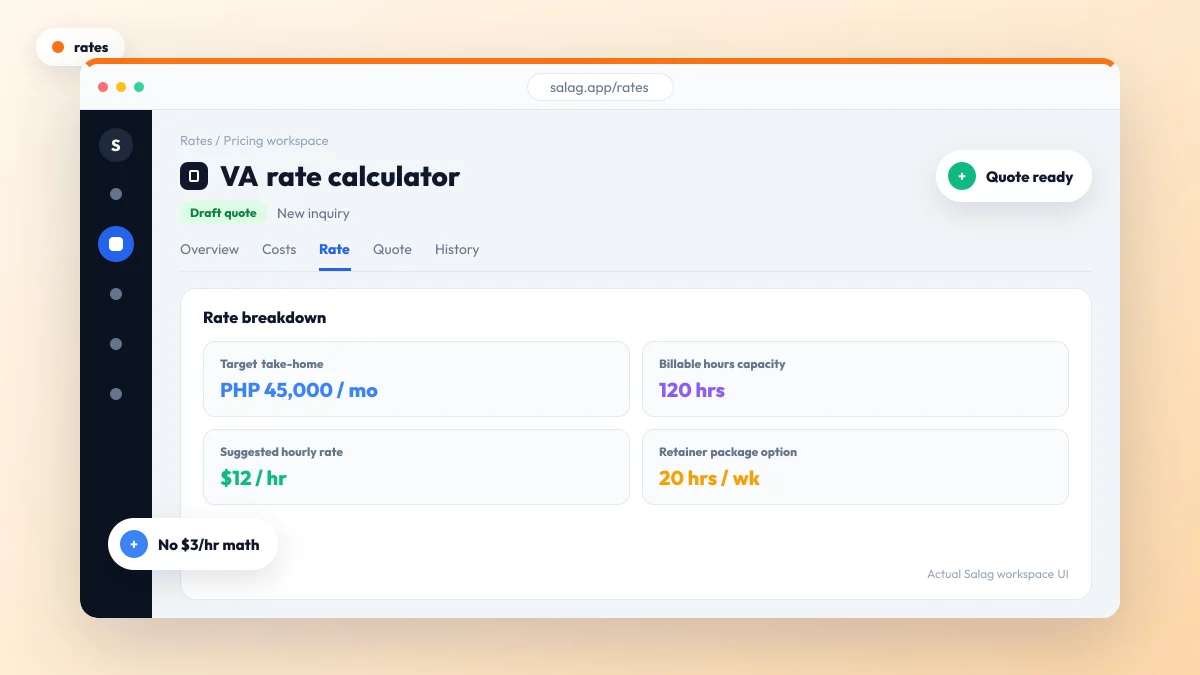
Decide your walk-away number before live chat. Boundary Memory in plain language: write Salag's $5/hr floor and your personal floor, then protect them when pressure hits.

 14 min read
Introduction
Most bad rates are born in the middle of a call.
The client sounds nice. The role sounds big. You want the yes. Someone asks, "What is your rate?" Your brain searches for a number that will not scare them. You say something low. Later you do the math. The math loses.
This guide teaches one habit: set rate floor before negotiation. Decide in quiet time. Speak from notes in live time. That habit is Boundary Memory in plain language: you remember the boundary you already wrote.
Salag's recommended floor is $5/hr. Your personal floor can be higher. It should not be coached below $5. Tools that help: Rate Calculator, Rate Negotiator, and Rate Evolution Monitor.
Why this matters
Filipino VAs often negotiate in three hard places:
- Zoom or Google Meet with a foreign client
- Upwork or OnlineJobs chat
- Viber or WhatsApp voice notes
All three reward fast answers. Fast answers without a floor become unpaid stress later.
Setting the floor first protects:
- Take-home after fees
- Sleep and hour caps
- Your next raise talk
- Your self-respect when someone says "others charge less"
It also protects the client relationship. Clear numbers early beat silent resentment later.
Helpful companion posts:
- Why Salag recommends a $5/hour floor
- How to quote VA rate to a new client
- When to cut scope instead of cutting rate
- Raise VA rates email templates
Key concepts
Floor vs target vs wish
Floor: lowest acceptable rate for this scope. At or above $5/hr.
Target: the number you actually propose.
Wish: nice-to-have if the client wants rush or premium access.
Write all three before the call. Say the target. Protect the floor.
Boundary Memory (plain language)
Boundary Memory means your future self can recall a decision made when you were calm.
Example: sticky note or phone note that says, "Floor $6/hr for inbox + Shopify macros. Walk away below $5.50 for this scope. No weekends."
During the call you look at the note. You do not reinvent ethics under charm pressure.
Walk-away line
A walk-away line is one polite sentence that ends the deal if the client stays under floor.
You write it before you need it. You practice it once out loud.
Private floor vs public quote
Your private floor stays private. Your public quote is the offer package. Mixing them live often causes accidental discounts.
Build your floor before any call
Step 1: Cost stack in pesos, then USD
List monthly freelance costs you actually pay: internet share, tools, electricity bump, coworking, headset replacements over a year, tax reserve.
Divide by realistic billable hours, not fantasy 160.
Convert to USD with a cautious rate. Add fee buffer. Land at a personal floor. If it sits under $5/hr, raise the floor to $5 anyway. Salag does not coach sub-$5 starts.
Use Rate Calculator so the math is not vibes.
Step 2: Scope snapshot for this lead
Write five lines max:
- Main tasks
- Tools
- Hours estimate
- Overlap window
- Not included
Vague leads get higher risk floors or a paid discovery pilot only.
Step 3: Choose floor, target, walk-away
Example structure (illustrative only):
- Floor: $5.50/hr for the listed scope
- Target: $7/hr or $900/month package with cap
- Walk-away: below $5/hr or unlimited Slack after hours
Step 4: Write the walk-away sentence
Keep it kind and final.
Thanks for sharing the budget. For this scope I stay at $[floor]/hr or a slim package at the same floor with fewer tasks. If that does not fit, I am happy to reconnect later when priorities change.
Step 5: Put notes beside the call
Phone note, printed sticky, or Notion open. Boundary Memory fails if the note is buried.
ALIGN Protocol before live negotiation
A: Agree with yourself first
Agree your floor and hour cap privately. Then agree scope facts with the client in writing after the call.
Checkpoint: Is your floor written before you join the meeting?
L: List proof you can mention
Samples, past delivery summaries, tools you know. Proof supports target rates. Salag can store trails later. Salag does not attest that you are "senior."
Checkpoint: Can you name two concrete proofs without overselling?
I: Install the call agenda
Agenda: goals, tasks, hours, tools, timeline, budget range, next step = written quote.
Checkpoint: Did you tell them you will send numbers in writing after?
G: Guard improvisation
No live final discounts below floor. No "I can do anything." Offer to slim scope instead.
Checkpoint: Did you refuse to finalize a below-floor number on the spot?
N: Net the payment talk early
Ask preferred payout method and timing. Fees affect floor. See Wise to GCash fees.
Checkpoint: Do you know how money will move before you lock a rate?
Step-by-step: day-of call checklist
- Open floor note.
- Open scope snapshot.
- Open Rate Negotiator script you practiced.
- Join on time.
- Listen and take notes for 10 minutes before quoting.
- Restate scope in your words.
- Say you will confirm numbers in a short quote email.
- If pressed for a range, give target band above floor, not floor itself.
- If budget is far below floor, offer slim package or polite exit.
- End with next step and timing.
- Send written quote within the promised window.
- Archive call notes with the quote.
Script: when they ask for your rate mid-call
I can share a range after I confirm scope. For similar work I usually quote around $[target]/hr with a monthly cap, and I send the exact package by email today so everything is clear.
Script: when they push below your floor
I understand the budget. I do not go below $[floor]/hr for this scope. I can remove [tasks] and keep [core] at $[floor or package]. Or we pause and revisit later.
Script: when they compare you to someone cheaper
Totally fair to compare. My rate ties to [hour cap], [tools], and [response window]. If you need a lower spend, I can propose a smaller package rather than the same work for less.
Mistakes that break Boundary Memory
Writing the floor in your head only
Heads forget under pressure. Paper remembers.
Setting floor after you hear their budget
Then it is not a floor. It is a reaction.
Using $4 "just to get in"
Salag treats that as underpaying territory to skip, not a strategy.
Apologizing while stating the floor
"Sorry but my rate is..." teaches them your boundary is optional. Drop the sorry.
Finalizing on voice only
Voice is discovery. Email is agreement. Send the quote.
Mixing friend energy with client math
Warmth is fine. Free floating discounts are not. If friends hire you, still write floors.
Ignoring fee reality
A $5/hr gross that becomes much less after platform fees may violate your real floor. Price fees in.
Worked example: Jun before a Shopify VA interview
Before call (example only):
Jun runs Rate Calculator. Personal floor lands near $6/hr after tools and fees. Salag minimum is $5, so he is already above. Target $8/hr. Walk-away: below $6 for full inbox + customer chat.
Note on phone:
Floor $6. Target $8. Cap 80 hrs. No weekends. Walk-away script ready.
On call: Client says budget is "around $4."
Jun does not bargain down live. He offers a slim package: order notes only, 30 hours, at $6/hr. Or full scope at $8. Client chooses slim.
After call: Jun sends quote email with inclusions. Starts after written yes and first payment timing agreed.
Boundary Memory worked because the $4 moment hit a pre-written wall.
How Salag helps
- Rate Calculator: build the number before the meeting.
- Rate Negotiator: practice the lines so live talk is recall, not invention.
- Rate Evolution Monitor: keep floors from quietly rotting across months.
- Project Scope Calculator: turn fuzzy job posts into hour estimates before you price.
Salag documents delivery and payment trails once work starts. Salag does not attest skill. Your floor is still your responsibility to defend.
Comparison: deciding live vs deciding early
| Moment | Decide live | Decide before call |
|---|---|---|
| Rate asked | Panic number | Target from notes |
| Budget low | Instant discount | Slim package or exit |
| Scope fuzzy | Overpromise | Paid pilot or clarify first |
| Fees | Forgotten | Built into floor |
| After call feeling | Regret | Clear next step |
When to re-apply Boundary Memory
- New niche or harder tools
- Fee tables change
- You raised living costs or tax reserve
- A client asks for a long retainer
- You feel tempted to go below $5/hr
- You have not reviewed personal floor in 90 days
Also re-apply before any "quick hop on a call" that might become a negotiation.
Definitions
Rate floor: Lowest acceptable pay for a defined scope. Salag minimum $5/hr.
Boundary Memory: Recalling pre-written limits during live pressure.
Walk-away line: Polite sentence that ends a below-floor deal.
Target rate: The number you propose when scope fits.
Written quote: Email or doc that locks scope, rate, and payment timing.
ALIGN Protocol: Agree, List proof, Install agenda/tools, Guard improvisation, Net payment facts.
Delivery and payment trail: Record of work sent and money received. Not a skill certificate from Salag.
Extra practice: 10-minute pre-call drill
- Open calculator (2 minutes).
- Write floor/target/walk-away (2 minutes).
- Write three scope bullets (2 minutes).
- Read walk-away line out loud twice (2 minutes).
- Open note beside camera (2 minutes).
Do this even for "informal chats." Informal chats hire people too.
Script: ending a call without a locked low rate
Thanks for the conversation. I will send a short quote for [scope] by [time]. If the budget needs to stay under my floor, I will include a slim option so you can choose clearly.
More practice: sticky-note floors for common seats
Write separate floors for common offer types so you are not inventing mid-call.
Inbox and calendar VA
- Floor near your personal number at or above $5/hr
- Target higher when you own macros and weekly summaries
- Walk-away: unlimited personal errands mixed into work chat
Ecommerce VA
- Floor accounts for tool hopping and peak season hours
- Cap rush weeks with overage language before Black Friday talk starts
- Walk-away: owner expects 24/7 replies with no night differential
Lead gen VA
- Floor includes research time, not only dial time
- Exclude fake lead guarantees from your offer language
- Walk-away: pay only per lead with unpaid hours buried in sourcing
Script: ask for time instead of a live final number
I want to give you a clean number tied to scope. I will send a short quote within [X hours] with rate, hour cap, and exclusions. That keeps us aligned and avoids guessing on the call.
Script: when they say budget is flexible but push low anyway
Flexible helps. My floor for this scope is $[floor]/hr. If we need to fit a lower monthly number, we reduce tasks with the Project Scope Calculator logic and keep the floor.
Use Project Scope Calculator after the call when tasks are still fuzzy. Fuzzy plus live discounts is how floors die.
If you support multiple clients, keep one note file per seat. Boundary Memory is easier when each client has a named floor line, not one blurry number for everyone.
After the call: lock the boundary in writing
Boundary Memory fails if the call ends with only a verbal maybe.
Within the time you promised, send a quote that repeats floor-safe numbers. Use the structure in how to quote virtual assistant rate to a new client.
Quote must include
- Scope bullets
- Rate or package price
- Hour cap
- Exclusions
- Payment timing
- Quote validity window
Script: post-call quote opener
Hi [Name],
Thanks for the conversation earlier. Per our discussion, here is the written offer for [scope].
Rate: $[target]/hr (or package $[amount]/month)
Cap: [hours]
Included: [list]
Not included: [list]
Start after: written confirmation and [deposit or first invoice timing]This offer is valid until [date]. If you need a lower monthly spend, I can send a slim-scope alternate at the same floor quality.
If they try to reopen below-floor bargaining in chat after the quote, point back to the email. Do not renegotiate the floor in fragments across apps.
When multiple decision makers join late
Sometimes a founder loves your target rate, then a partner asks for half. Your pre-call floor still rules. Resend the same written options. Do not create a secret side deal with the nicer person.
Script: second stakeholder pushes lower
Thanks for looping in. The offer below is the same package I sent [Name]. I can adjust spend by reducing scope, not by going below $[floor]/hr for the full list.
Option A: full scope at $[target]
Option B: slim scope at $[slim package]Happy to jump on a short call to choose, then confirm in email.
Track accepted floors in Rate Evolution Monitor so six months later you remember what you agreed when you were calm.
Final thoughts
If you set rate floor before negotiation, the call becomes a conversation, not a trap. Boundary Memory is not fancy theory. It is a note you can see while you speak.
Hold $5/hr as the Salag minimum. Write your personal floor higher when costs demand it. Offer slim scope before cheap labor. Send numbers in writing. Keep Salag trails for delivery and payment. Your skill claims stay yours.
Before your next discovery call, write the floor first. Then join.
In short
To set rate floor before negotiation, write your lowest acceptable number and walk-away line before any live call. Use Salag's $5/hr as the minimum starting floor, then add your costs. Boundary Memory means you recall that paper, not invent a panic price. Salag stores delivery and payment trails; it does not attest skill.
Common questions
To set rate floor before negotiation, write your lowest acceptable number and walk-away line before any live call. Use Salag's $5/hr as the minimum starting floor, then add your costs. Boundary Memory means you recall that paper, not invent a panic price. Salag stores delivery and payment trails; it does not attest skill.
It means you write the lowest rate you will accept before a live call or chat. During the talk you recall that number instead of inventing one under pressure. Salag's recommended floor starts at $5/hr.
Boundary Memory is remembering your pre-written limits when a client asks for a lower rate or more work. You decide the floor and walk-away line in calm time, then follow them in live time.
Live pressure makes many freelancers say yes too fast. You may drop below your costs, forget fees, or accept vague scope. A written floor reduces that snap decision.
Yes. Salag recommends $5/hr as the minimum professional floor. Do not treat $4/hr or below as Salag coaching. Underpaying posts are skip warnings, not a training plan.
Include the lowest acceptable rate for that scope, the hour cap, what is not included, and the polite exit sentence if the client stays below your floor. Write it before the call.
Yes. $5/hr is the Salag minimum starting point. Your tools, tax reserve, experience, and niche may push your personal floor higher. Never set it below $5 as Salag guidance.
Run costs, fees, and realistic billable hours in the Rate Calculator. Save the result as your floor for that offer. Bring that number into the call notes, not a guess.
Repeat your written floor and offer a slim package if needed. Do not invent a lower number live. Ask to send a written quote after the call instead of finalizing under pressure.
No. Salag documents delivery and payment trails. It does not attest skill. Your floor is cost and boundary math. Higher rates still need client agreement and your own proof.
Usually quote your target offer, not your private emergency floor. Keep the walk-away number for yourself. Share the offer tied to clear scope.
Set the floor privately first, then send a structured quote. See how to quote virtual assistant rate to a new client for the email structure after discovery.
You can correct in writing for the next period. Explain the scope and fee reality, then propose the updated rate or a reduced package. Do not stay stuck forever because of one rushed yes.
Yes. Practice scripts in Rate Negotiator before live talks. Use short lines you already wrote so Boundary Memory kicks in when pressure rises.