
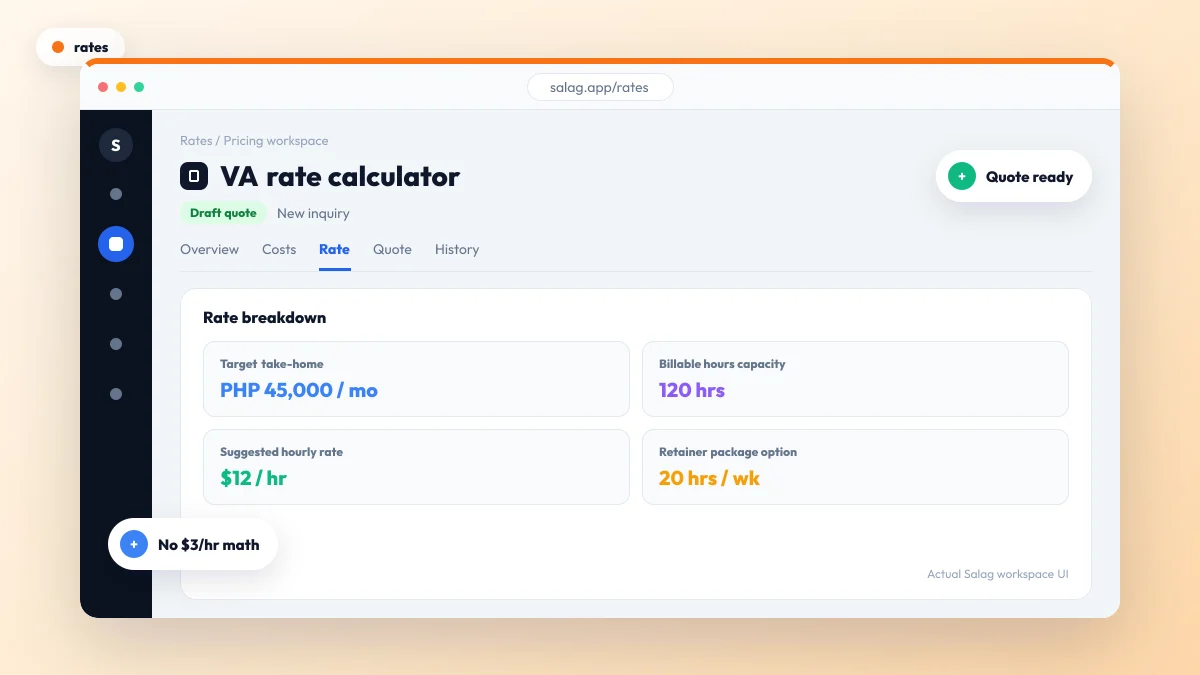
When a client pushes on price, shrink the written scope at your full rate. Keep Salag's $5/hr floor. Never teach them your number was fake.

 14 min read
Why this matters for Filipino VAs
Overseas clients often push on price. Many Filipino freelancers answer with a quiet cut. It feels polite. It costs you for years.
The problem is rarely "you are too expensive for who you are." The problem is usually "this budget does not fit this list of work."
Those are different fixes:
| Client signal | Wrong fix | Better fix |
|---|---|---|
| "Budget is only $X" | Same scope, lower rate | Smaller written scope at full rate |
| "Someone quoted less" | Race down | Show your list vs their list |
| "Can you do a bit cheaper?" | Vague yes | Ask what to remove |
This is not a trick to make them feel anything. It is an honest match between work and money. Salag's job in this story is simple: help you keep agreement → deliverables → approval → invoice → payment on one clear record. Salag does not attest that you are "worth" a rate. Your artifacts do.
What cutting rate actually teaches
Once you cut the rate on the same scope, three things stick:
- Your first number looked soft. Next renewal starts from the lower number.
- Scope stays fat while pay thins. You still do the hard parts. You just earn less.
- You lose your floor. If you were near Salag's $5/hr recommendation, a "small" cut can put the job under a sustainable line.
Cutting scope does the opposite. The client sees what they are buying. You keep a rate you can defend later.
Related reading: How to refuse underpaying VA jobs and Why Salag recommends a $5/hr floor.
ALIGN for a price pushback
Use a short protocol before you reply.
A: Ask what the limit is.
Is this a hard budget, sticker shock, or a test?
L: List the current scope.
Open the quote or email. Name deliverables, hours, revisions, tools, and turnaround.
I: Isolate what can move.
Which items are must-have vs phase two?
G: Give two written options.
Full package at full rate. Slim package at full rate (or honest decline).
N: Note it in the thread.
Same email chain. No side chat that vanishes.
You are not mirroring feelings or creating fake urgency. You are putting a clear choice in writing.
Step 1: Diagnose before you move
Do not answer "can you do cheaper?" with a new number.
Ask one clarifying question:
Hi [Name], thanks for the note. To help me adjust cleanly: is $[budget] a hard cap for this phase, or does the full scope still matter if we stretch timing or split into two phases?
That question sorts three cases:
- Hard budget. Scope must shrink or the deal pauses.
- Sticker shock. They need a clearer breakdown of what the fee covers.
- Fishing. They will take a cut if you offer one for free.
Only case 1 and a clear case 2 need a slim package. Case 3 needs a calm hold.
Step 2: Restate the full scope in one block
Clients forget what they asked for. Put it back in front of them.
Here is the full scope I quoted at $[rate] / [package price]:
- [Deliverable A]
- [Deliverable B]
- [Deliverable C]
- [N] revision rounds
- [Channels / tools / meeting load]
- Turnaround: [X business days]
That package stays at $[rate].
This is your evidence. Not adjectives. Not "I work hard." The list.
If you do not have a written list yet, stop and write one before negotiating. See defining project scope templates and scope agreement checklist.
Step 3: Build a slim package (same rate)
Shrink volume, not integrity.
Good cuts:
- Fewer weekly hours
- Fewer channels (email only, not email + Slack + WhatsApp)
- Fewer revision rounds
- Drop low-impact tasks
- Move research, reporting extras, or "nice" dashboards to phase two
- Longer turnaround (if rush was priced in)
Bad cuts:
- Same hours, lower rate
- "I'll just work faster for less"
- Unlimited revisions "because the fee is lower"
- Free trial that becomes free ongoing work
Example slim offer:
If we need to land near $[budget], here is Option B at the same rate:
- Keep [A] and [B]
- Move [C] to phase two
- Cap revisions at [N]
- Cap meetings at [N]/month
- Fee: $[slim total] (still based on $[rate])
Option A stays the full list at $[full total]. Tell me which option you want in writing and I will send the updated scope.
Use Project Scope Calculator if you need help sizing hours before you send numbers.
Step 4: Hold the floor
Salag's recommended professional floor is $5/hr for USD-billed VA work with clear scope.
If their budget only works below your floor after an honest slim-down, decline.
Thanks for checking. Even with a reduced scope, I can't deliver this well under my $[floor]/hr floor. If the budget can meet Option B, I'm ready. If not, I'm happy to reconnect when the scope and budget line up.
No apology spiral. No fake "maybe later discount."
More context: how to quote a VA rate to a new client.
Step 5: Put the choice in writing, then stop talking
After you send Option A / Option B:
- Wait for a written pick.
- Update the agreement or confirmation email.
- Start only after they confirm the slim list.
- Invoice against that list.
If they say "let's start with the cheap price and add the rest later" without paying for the rest, that is unpaid expansion. Pause. See handling scope expansion and out-of-scope request scripts.
Scripts you can paste
Budget is tight
Hi [Name],
I hear you on the budget. I don't discount the same scope, because the rate maps to the work list.
Option A: full scope at $[full] as quoted. Option B: [A]+[B] only, [N] revisions, fee $[slim], same rate basis.
Reply with A or B and I'll send the updated written scope the same day.
"We found someone cheaper"
Thanks for being direct. Cheaper quotes often cover a shorter list. Happy to compare scopes side by side.
If you need a lower total, Option B below keeps my rate and trims [C] and extra meetings.
If you need the full list, my quote stands.
They want a free cut
I can adjust scope or timing. I can't cut the rate on the same list. Want me to send a slim package that fits $[budget]?
Retainer pressure
For retainers, the clean lever is hours and task list, not a lower hourly.
Example: 40 hrs/mo at $[rate] = $[total]. Slim: 25 hrs/mo at $[rate] = $[slim], with [task list].
Same rate. Smaller capacity.
For retainer structure detail, see retainer vs project pricing.
Comparison: discount vs scope cut
| Move | What the client learns | What you keep | Risk |
|---|---|---|---|
| Cut rate, same scope | Your price was soft | Less money | Every future deal starts lower |
| Cut scope, same rate | Price maps to work | Rate integrity | Need clear writing |
| Three fixed packages | They choose a tier | No live haggling | Must define tiers early |
| Walk away under floor | You have a real floor | Time and energy | Short-term lost deal |
Common mistakes
- Cutting first, documenting later. Always write the slim list first.
- Cutting rate "just this once." Once becomes the new normal.
- Vague "I'll do less." Less of what? Name tasks.
- Keeping WhatsApp + Slack + email on a slim fee. Channels are scope.
- Going under $5/hr to stay liked. Likability does not pay rent.
- Using pressure language. No fake scarcity. No guilt. Clear options only.
- Starting work while they "think about it." Confirmation first.
Example: inbox VA quote
Full quote: $8/hr × 40 hrs/mo = $320. Includes inbox triage, calendar, travel research, weekly report, Slack + email.
Client: "We only have $220."
Wrong: "$5.50/hr for the same work."
Better Option B: $8/hr × 25 hrs/mo = $200. Includes inbox + calendar only. Travel research and weekly report move to phase two. Email only, no Slack. 2 revision rounds on process docs.
Same rate. Smaller list. Still above the $5/hr floor.
When a tiny trade is okay (still not free)
If you ever move a number, trade something real:
- Longer commitment (3-month retainer)
- Faster payment (deposit or weekly billing)
- Fewer revisions
- Fewer meetings
Never trade rate for "exposure." Never trade rate for a promise of "more work later" with no date and no scope.
Discount trades belong in a separate playbook. This post's default remains: move scope, hold rate.
How Salag helps
Salag is built so the engagement has one trail: agreement, deliverables, approval, invoice, and payment.
For this negotiation:
- Write the full and slim scopes before you reply.
- Use Rate Negotiator when you need a calm structure for the message.
- Use Project Scope Calculator to size hours.
- Use Scope Creep Detector after the job starts if extras return.
- Keep approvals and invoices on the same client record so the next rate talk has history, not adjectives.
Salag documents what happened. It does not certify your skill. Your pricing case should rest on the record of delivered work and paid invoices, not on claims Salag cannot make.
When to re-apply this playbook
- New quote gets "too expensive"
- Retainer renewal with a lower budget
- Client compares you to a cheaper bidder
- You feel tempted to cut "just to close"
Re-apply before you type a lower rate. Open the scope list first.
Definitions
Rate: What you charge per hour or per package unit.
Scope: The written list of work, caps, channels, and revisions.
Floor: The lowest rate you will take for clear professional work. Salag recommends $5/hr as that starter floor for USD-billed VA work.
Slim package: A smaller written list at the same rate.
Phase two: Work parked for a later paid agreement.
Final thoughts
Price pushback is usually a budget-to-list mismatch. Fix the list.
Keep your rate. Cut the extras. Write both options. Hold the $5/hr floor. Start only after the client picks a package in writing.
That is rate defense with evidence. Not sales psychology. Not anti-client theater. Just a clean deal both sides can point to later.
In short
When a client says your price is too high, cut scope instead of cutting rate. Shrink the written deliverables, hours, or revisions at your full rate. Keep Salag's $5/hr floor. Put the slim package in writing before you start. A discount for the same list teaches them your number was fake.
Common questions
When a client says your price is too high, cut scope instead of cutting rate. Shrink the written deliverables, hours, or revisions at your full rate. Keep Salag's $5/hr floor. Put the slim package in writing before you start. A discount for the same list teaches them your number was fake.
When the client has a real budget limit but still wants quality work. Shrink the written deliverables, hours, or revision rounds. Keep your full rate. If they want the full list at a lower number, that is a no-fit, not a discount moment.
A rate cut teaches the client your first number was soft. The next deal starts lower. A scope cut keeps the rate honest and matches work to budget.
Salag recommends $5/hr as the professional floor for USD-billed VA work with clear scope. Do not coach yourself under that floor to "win" a deal.
Thank them, restate the full scope and rate, then offer a smaller written package at the same rate. Keep it short. Put the options in the same email thread as the original quote.
Cut nice-to-haves first: extra revision rounds, non-urgent channels, weekly extras, and low-impact tasks. Keep the core outcomes that make the job useful.
Yes. A light, standard, and full package at fixed prices lets the client choose scope. The rate per package stays fixed. You are not haggling live.
Say the full list needs the quoted rate. Offer the slim package that fits their budget, or pause. Do not quietly agree to full scope at a cut rate.
Always. List what stays, what moves to phase two, hours or deliverable caps, revision limits, and the rate. A verbal "we'll do less" becomes unpaid expansion later.
Mid-project creep is new work after you already started. This guide is about price pushback before or at quote time. Both need a written change. Different moment, same rule: change the list, not your integrity on rate.
Only if you trade something real: longer term, upfront payment, fewer revisions, or a smaller package. Never discount for free. Never go under your floor.
Use a written scope list, a rate calculator for your floor, and a clear reply that names options A and B. Salag's Rate Negotiator and Project Scope Calculator help you stay consistent.
No. It means you match work to budget. Clients who need the full package pay the full rate. Clients with a smaller budget get a real smaller package.
Stay calm. Confirm your scope and rate. Offer a slim package if useful. Do not race to the bottom. Cheap and clear are different products.
Salag documents agreement, deliverables, approval, invoice, and payment on one timeline. It does not certify your talent. Your rate case rests on the written record of what you deliver and get paid for.