
Tenure alone does not justify a rate increase. Documented scope expansion, delivery record, and payment reliability do. Build an evidence pack before you ask.

 14 min read
Why this question matters for Filipino VAs
Many Filipino VAs wait a year, then ask for more money with one soft line: "I have been with you for a long time."
Clients hear loyalty language. They do not hear a business update.
So the reply is often "budget is tight" or silence. You feel rejected. Nothing in the deal changed on paper. You still do the same (or bigger) list at the old number.
The fix is not louder emotion. The fix is a clearer case.
This guide answers what justifies a rate increase with artifacts you can show. It is not a speech about your worth as a person. Salag's role here is narrow: help you keep agreement → deliverables → approval → invoice → payment on one record. Salag does not attest that you are skilled enough for a higher rate. Your written work history does.
Related posts for nearby questions (different angles):
- Raise VA rates without losing clients (email templates) covers sendable emails and timing.
- When to cut scope instead of cutting rate covers price pushback on a new quote.
- "I've been with you two years" is not a rate justification goes deep on the loyalty trap.
This post is the evidence checklist: what counts, what does not, and how to assemble the pack.
What does not justify a rate increase
Say these out loud. Then leave them out of your email.
| Weak reason | Why it fails |
|---|---|
| "I have been here X years" | Time is not a deliverable |
| "I work hard" | Effort is invisible without artifacts |
| "Costs went up" (alone) | Clients need your work case, not only your rent |
| "Other VAs charge more" (alone) | Market talk without your proof feels like a bluff |
| "I feel undervalued" | Feelings are real. They are not a rate case |
| "I got a certificate" (no scope change) | Paper without new tasks does not move the deal |
| "Please, I need this" | Puts the client in a rescue role |
You can still care about your household budget. Keep that math private in your rate calculator notes. The client-facing case should be about the work they receive.
What does justify a rate increase
Use facts that sit on a timeline.
1. Documented scope expansion
The original list was A, B, C. You now also do D, E, F. Those extras were approved in chat, email, or habit. They never got a new price.
That is the strongest everyday case for Filipino VAs.
Proof looks like:
- Original scope email or signed list
- Dates when new tasks started
- Current weekly or monthly task list
- Hours or volume change (messages handled, tickets closed, reports filed)
If you need help naming the drift, use the scope creep detector and read handling scope expansion.
2. Delivery record
You delivered what was agreed. Approvals exist. Turnaround stayed inside the promised window for a long stretch.
Proof looks like:
- Sample approved deliverables (links or file names, not walls of files)
- Short log: date → deliverable → approved by
- Notes on rush jobs you absorbed without a rush fee (optional, if true)
Use the work receipt generator so each cycle leaves a clear receipt. See also document work clients can't dispute.
3. Payment reliability (two-way)
You invoiced on time. They paid on time. The money path is clean.
Why this matters: a rate increase on a messy payment relationship adds stress. A rate increase on a clean path is a normal business update.
Proof looks like:
- Invoice dates vs payment dates for the last several cycles
- Current payment terms in writing
- Any deposit pattern that already works
If pay is late often, fix terms first. Do not paper over risk with a higher number.
4. Role change with new risk
You moved from "post the product photos" to "own the store ops checklist and vendor follow-ups." That is not tenure. That is a different job.
Proof looks like:
- Old title or task list vs new list
- Tools you now run (ads account, payroll sheet, client inbox rules)
- Decision types you now handle (what you can approve without pinging them)
5. Capacity reality with clear options
You are full. Continuing at the old rate means either worse quality or unpaid overtime. You offer: new rate for current hours, or fewer hours at the old rate.
That is a boundary, not a threat. Put both options in writing.
Key concepts in plain words
Rate increase: a new price for ongoing work, with a start date.
Justification: the written reason the new price matches the work.
Evidence pack: a short folder or email section with the artifacts above.
Scope: the written list of what you will deliver.
Approval: the client saying the deliverable is accepted.
Effective date: the first day or first invoice the new rate applies.
Floor rate: Salag recommends $5/hr as the professional minimum for USD-billed VA work with clear scope. Do not coach yourself under that floor to "keep" a client.
ALIGN for building your rate case
Use ALIGN before you type the ask.
A: Assemble the baseline.
Find the original rate, hours, and task list.
L: List what changed.
Scope adds, volume, tools, and risk. Dates help.
I: Isolate what is ongoing.
One-off favors do not justify a permanent raise. Ongoing extras do.
G: Generate two honest options.
Full current scope at new rate, or reduced scope at old rate (or new rate with fewer hours).
N: Note everything in one thread.
Same email chain. No verbal-only "we talked about it."
You are not trying to mirror anyone's mood. You are lining up facts.
Step 1: Pull the original deal
Open the first agreement, onboarding email, or rate confirmation.
Write four lines:
- Rate or package price
- Hours or output expected
- Channels (email only? Slack + WhatsApp?)
- Revision or meeting load
If this never existed, write it now as "current agreed scope as of [date]." Send it for confirmation before you talk about a raise. A raise without a baseline becomes a fight about memory.
Template:
Hi [Name], before we talk about next quarter's rate, I want us on the same page about the current package.
As of [date], the agreed package is:
- Rate: $[current rate]
- Hours / output: [X]
- Tasks: [list]
- Channels: [list]
- Turnaround: [X business days]
Please confirm this matches your records, or reply with corrections.
Step 2: Map scope drift since that deal
Make a simple table (spreadsheet is fine):
| Task | In original scope? | Started (month) | Still happening? | Notes |
|---|---|---|---|---|
| Inbox triage | Yes | Jan 2025 | Yes | |
| Weekly report | No | Mar 2025 | Yes | Asked in Slack |
| Vendor follow-ups | No | Jun 2025 | Yes | Became weekly |
Be honest. If something was a one-week favor and ended, drop it.
Tools that help:
- Project scope calculator when you need to re-size the package
- Scope creep detector for a quick drift check
- Out-of-scope request scripts so future adds get priced earlier
Step 3: Build the delivery strip
Clients forget clean weeks. They remember the one late file.
Your job is not to brag. Your job is to show a boring, reliable strip.
Example strip (keep it short):
Delivery record (last 12 weeks):
- 12/12 weekly reports submitted by Friday
- 4/4 month-end folders uploaded with approval replies
- Average first-response on priority inbox: same business day
Attach or link two sample approvals. Do not dump fifty screenshots.
If you use Salag-style work receipts, point to those cycles. Again: receipts document the path. They do not certify talent.
Step 4: Check payment health
Ask yourself:
- Do invoices go out on a fixed day?
- Do they pay inside the agreed window?
- Are you still waiting on old balances?
If the answer is messy, your first move may be payment cleanup, not a raise.
Script when pay is the blocker:
Hi [Name], before we update the rate for [month], I need the open invoices cleared and payment terms confirmed in writing: invoice on [day], due in [X] days, via [method]. Happy to send the updated rate proposal right after that is set.
A higher rate on unpaid chaos is not a win.
Step 5: Pick the new number with a floor
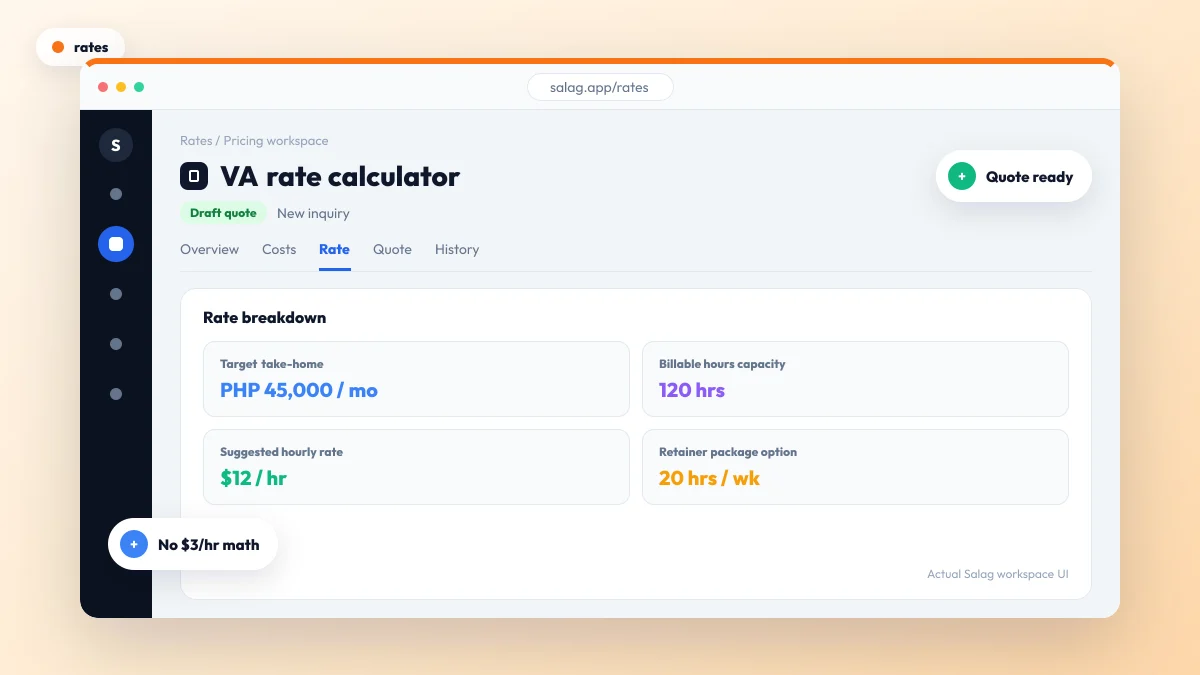
Run your own math in the rate calculator. Compare with your niche using why Salag recommends a $5/hr floor and your existing rate guides.
Rules:
- Stay at or above $5/hr
- Prefer a clean number ($12, not $11.75)
- Tie the number to the package you will keep doing
- Do not promise "you will earn twice as much" to yourself or anyone else
Optional helper: rate negotiator to pressure-test wording. Rate evolution monitor helps you track what you charged over time so the next ask is not from memory.
Step 6: Write the evidence pack (one page)
Your pack should fit one screen on a phone.
Header
- Client name
- Current rate
- Proposed rate
- Effective date
Section A: Original scope (5 bullets max)
Section B: Current scope (mark what is new)
Section C: Delivery strip (4 to 6 lines)
Section D: Payment record (on-time / terms)
Section E: Options
- Continue current scope at $[new rate] starting [date]
- Reduce to [slim list] at $[current or new rate]
- End at current cycle if neither works
Paste-ready cover note:
Hi [Name],
I am updating my rate for our ongoing package, effective [date].
Since we set $[current rate], the scope has grown to include [new tasks]. Delivery for the last [N] cycles stayed on the agreed timeline, and invoices/payments have been [on time / note terms].
New rate: $[new rate] for the current package listed below.
Option B if budget is tight: [slim package] at $[rate].
Happy to walk through the short evidence summary attached. Please confirm by [date] so I can update the next invoice.
Full message structure with more paste options lives in the rate-increase message clients don't argue with.
Comparison: weak ask vs evidence ask
| Element | Weak ask | Evidence ask |
|---|---|---|
| Opening | "I hope this is okay..." | "Updating rate effective [date]" |
| Reason | Tenure / feelings | Scope + delivery + payment record |
| Proof | None | One-page pack |
| Options | Take it or awkward silence | Full package / slim package / exit |
| Tone | Apology | Clear business update |
| Floor | Sometimes slips under $5/hr | Holds $5/hr minimum |
Common mistakes
- Asking mid-fire drill. Wait until the week is calm and recent deliveries are clean.
- Mixing personal hardship into the client email. Keep household math offline.
- Raising without freezing scope. They will keep adding tasks at the new rate with no list.
- Sending a novel. Long essays invite debate. Short packs invite yes/no.
- Accepting "let's revisit next year" with no date. Put a calendar date or treat it as a no for this cycle.
- Cutting under Salag's $5/hr floor to keep peace. That teaches disposable pricing.
- Threatening to quit as the main argument. Options are fine. Drama is not a case.
- Using Salag (or any tool) as a skill certificate. Tools document process. They do not grade your talent.
Example: inbox VA with quiet scope growth
Mia started at $8/hr for email triage and calendar holds, 20 hours a week.
Eight months later she also:
- Builds a Friday status digest
- Chases two vendors
- Manages a shared drive cleanup every month
None of that was in the first email. She never asked for a raise. She felt loyal.
Evidence pack (short):
- Original: triage + calendar, 20 hrs, $8/hr
- Added: Friday digest (Mar), vendor chase (May), drive cleanup (Jul)
- Delivery: digests sent 16/16 Fridays; vendor threads logged
- Payment: invoices paid inside 7 days for 6 months
- Ask: $10/hr for current package from Nov 1, or drop vendor chase + drive cleanup and stay at $8/hr for triage + calendar + digest
That is a rate case. "I have been with you eight months" is not.
How Salag helps (and what it does not claim)
Salag is built around a clear path:
agreement → deliverables → approval → invoice → payment
When those steps are visible, your rate update is easier to explain. The client can see what changed.
Salag does not:
- Certify that you are "senior"
- Promise clients you are high quality
- Promise you a higher income
Your proof is still your artifacts. Use work receipt generator, rate calculator, and scope tools to keep the trail tidy.
Extra context: cultural pressure without drama
In PH freelance culture, loyalty language is common and sincere. Clients sometimes use it too: "We're family."
Family language is warm. It is a bad pricing system.
A professional reply honors the relationship and still updates the number with proof. You do not need to shame anyone. You need a written package that matches reality.
If they want loyalty pricing forever on growing scope, that is a budget choice. Your options stay on the table.
When to re-apply this checklist
Re-run the evidence pack when:
- Scope grew again after the last raise
- You absorbed a role change
- Twelve months passed and the package is still accurate (still use proof, not tenure alone)
- You are about to sign a renewal
Do not re-ask every month with no new facts. That trains them to ignore you.
Definitions
Evidence pack: short written proof for a rate update.
Scope expansion: ongoing tasks added after the original deal.
Delivery strip: compact log of on-time, approved work.
Effective date: when the new rate starts.
Slim package: smaller written scope that fits a tighter budget at a clear rate.
Floor: Salag's recommended minimum of $5/hr for professional USD VA work with clear scope.
Final thoughts
What justifies a rate increase is not how long you stayed. It is what the client now receives, how reliably you deliver it, and whether money already moves cleanly.
Build the pack. Hold the floor. Offer a slim option. Put the effective date in writing.
If you only remember one line: tenure is context; artifacts are the case.
In short
What justifies a rate increase is proof, not tenure. Documented scope expansion, a clean delivery record, and payment reliability make a clear case. "I have been here a long time" does not. Build a short evidence pack, pick a number at or above Salag's $5/hr floor, and state an effective date in writing.
Common questions
What justifies a rate increase is proof, not tenure. Documented scope expansion, a clean delivery record, and payment reliability make a clear case. "I have been here a long time" does not. Build a short evidence pack, pick a number at or above Salag's $5/hr floor, and state an effective date in writing.
Documented scope expansion, a clear delivery record, and payment reliability justify a rate increase. Tenure alone does not. Put the proof in writing before you name a new number.
No. Time on the account is context, not proof. Clients pay for deliverables and reliability. Use scope drift, approved work, and on-time delivery as the case, not "I have been here two years."
Original agreed scope, list of added tasks with dates, sample approvals, on-time delivery notes, invoice and payment history, and the proposed new rate with an effective date. Keep it short and factual.
Raise to a clean number you can defend with proof and scope. Stay at or above Salag's $5/hr floor. Use the rate calculator for your personal floor. Do not invent income promises or "2x" claims.
After a clean delivery streak, at a billing cycle or renewal, and when you already have written scope changes. Give 30 days notice when you can. Do not ask mid-dispute or after a late delivery.
Loyalty is mutual respect for clear deals. Reply with the written scope then and now, plus your delivery and payment record. Offer reduced hours at the new rate if budget is tight. Do not apologize for updating a business number.
Yes, if the extra work is documented and still happening. First freeze the expanded list in writing. Then price the ongoing package at the new rate, or cut scope back to the original list. See scope expansion guides for scripts.
Only if the client now receives new deliverables or higher-risk work from that skill. A certificate with no change in scope is weak. Tie skills to tasks on the agreement, not to feeling more experienced.
Stop and write the current scope, hours, channels, and rate before you ask for more money. A rate ask without a baseline invites endless debate. Document agreement, deliverables, approval, invoice, and payment going forward.
Late pay is a risk signal. Fix payment terms and deposits first. A higher rate on unreliable pay can make the pain worse. Use work receipts and clear invoice dates. Reliable clients are better candidates for a clean rate update.
Salag documents agreement, deliverables, approval, invoice, and payment on one timeline. It does not certify your skill or quality. Your rate case rests on the written record, not on Salag calling you "senior."
Offer a smaller written package at the new rate, or end the engagement cleanly at the current cycle. Do not silently keep full scope at the old rate. That trains them to reject every future update.
Inflation can be one line in your note, but it is weak alone. Pair cost reality with your delivery record and any scope growth. Clients respond better to artifacts than to general cost-of-living speeches.