
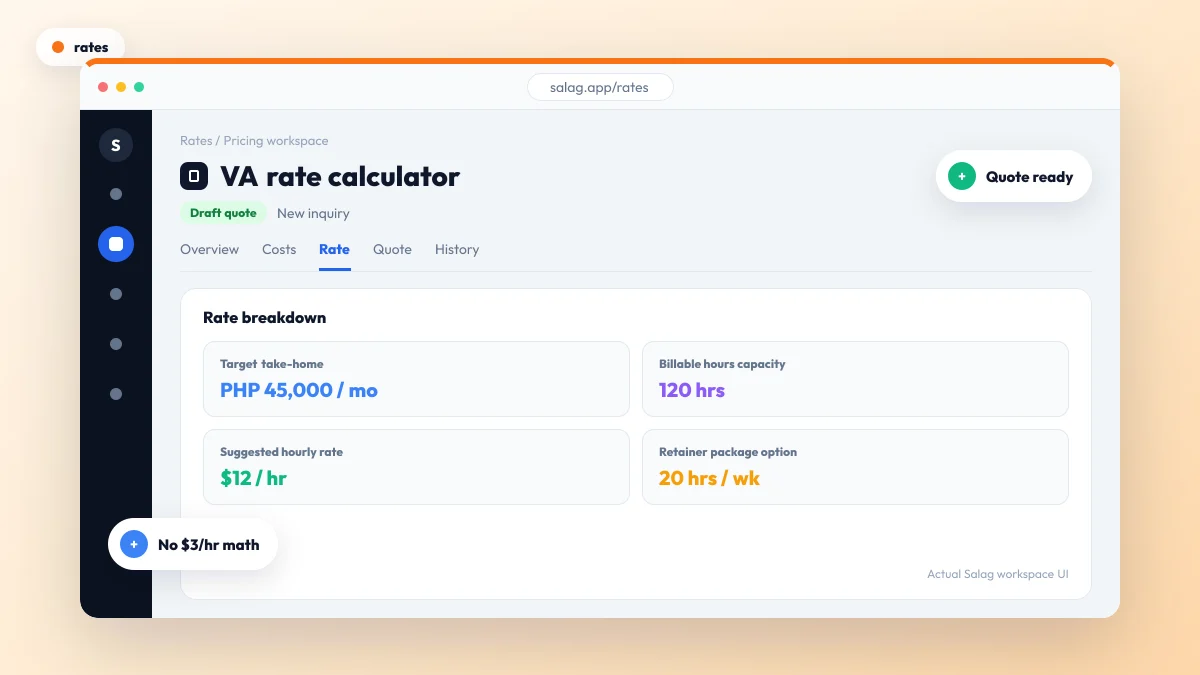
When clients ask for a discount, trade volume, term length, payment timing, or scope. Never gift a cut with the same workload. Keep Salag's $5/hr floor.

 14 min read
Introduction
"Can you give a discount?" is not automatically rude. It is a negotiation prompt.
The danger is answering with a free yes. Same tasks. Same chat. Same weekends. Smaller number. That is a donation.
This guide shows freelance discount what to trade so flexibility stays fair. Four trade levers:
- Volume
- Term length
- Payment timing
- Scope
Never give it away free. Hold Salag's $5/hr floor after the trade. When spend must fall, read when to cut scope instead of cutting rate.
Why free discounts hurt
Free discounts teach the wrong lesson: pressure works, boundaries do not.
They also hide math. A 20% cut on a package that already had unpaid Slack can push true rate under floor fast.
They damage future raises. Returning to normal rate feels like a punishment if the discount had no end date.
They confuse friends and referrals who heard your "special" number.
A trade fixes the story: both sides give something.
Related posts:
- Responding to we found someone cheaper
- Set your rate floor before the call
- Why Salag recommends $5/hour floor
- How to quote VA rate to a new client
- Raise VA rates email templates
- Wise to GCash fees
Key concepts
Discount vs trade
Discount: lower price.
Trade: lower price only when another term moves in your favor or scope shrinks.
True rate after trade
Compute money paid divided by true hours after the new deal. If it falls under $5/hr, the trade failed. Redesign it.
Time-bound vs forever
Forever discounts become your new floor without consent. Add an end date or quarterly review.
One lever at a time
Do not stack "cheaper + more work + slower pay." Pick one client win and one freelancer win.
Four trade levers in plain language
1) Volume
Client prepays a larger hour block or commits to a higher monthly minimum. You may offer a package price that still clears floor per hour.
Without prepay or firm minimum, "volume" is a wish.
2) Term length
Client signs three months with written caps. You offer a modest package rate for that window only. Review before month four.
3) Payment timing
Client pays deposit before start, or weekly, or same-week on invoice. You offer a small concession if fees and cash flow improve enough to matter.
4) Scope
Client wants lower spend. You remove tasks or channels. Rate per remaining hour stays healthy. This is usually the cleanest lever. Details in the cut scope guide.
ALIGN Protocol for discount talks
A: Agree the current deal first
Restate today's rate, hours, and inclusions before changing anything.
Checkpoint: Is the baseline written?
L: List what you need in return
Name the lever: volume, term, payment, or scope.
Checkpoint: Is the return concrete and dated?
I: Install numbers with calculator
Use Rate Calculator and Project Scope Calculator before you send the trade.
Checkpoint: True rate still ≥ $5/hr?
G: Guard freebies
If they reject every lever, keep full rate or decline. No silent yes.
Checkpoint: Did you avoid "sige, discount muna" with same scope?
N: Net the paper trail
Invoice shows trade. Email confirms end date. Salag can store delivery and payment history. Salag does not attest skill.
Checkpoint: Can you find the trade terms in one thread later?
Step-by-step: answer a discount request
- Thank them for asking directly.
- Open your floor note.
- Ask which constraint is real: cash this month, long budget, or unclear scope.
- Pick one lever that fits.
- Run true-rate math.
- Write option A (trade) and option B (full rate full scope).
- Optional option C: slim scope path.
- Send email, not only chat.
- Wait for written acceptance.
- Update invoice template and hour cap.
- Log in Rate Evolution Monitor.
- Review on the end date without ghosting the topic.
Script: refuse free discount, offer trades
Hi [Name],
I can be flexible with structure, not with unpaid cuts.
Options:
- Same scope at $[full rate], or
- $[adjusted package] if we [prepay X hours / commit Y months / pay within Z days], or
- Lower monthly spend by moving [tasks] out and keeping [core] at $[rate ≥ $5/hr].
Tell me which option fits and I will send the updated scope today.
Script: scope trade only
Hi [Name],
To meet the budget, I recommend cutting scope instead of cutting rate.
Keep: [list]
Pause: [list]
Monthly: [amount] for [hours] at $[rate].Extras return later as paid add-ons. This keeps quality on the core work.
Script: term-length trade
Hi [Name],
If we set a written [3]-month term with a hard cap of [hours]/month, I can offer [package price] through [end date].
On [review date] we return to standard rate or renegotiate with updated scope. Deposit of [amount] starts the term.
Script: payment-timing trade
Hi [Name],
If invoices clear within [X days] via [method], I can offer [small adjustment] for this scope.
If payment slips past [rule], rate returns to $[full] on the next billing period. Floor remains at or above $5/hr after fees.
Script: firm no when no trade appears
Hi [Name],
I cannot reduce the price for the same workload. Happy to continue at $[rate] with the current scope, or redesign a smaller package. If neither works, I understand and can help with a clean wind-down.
Mistakes to avoid
Percent discounts with no end date
"10% forever" becomes invisible erosion.
Discounting below floor for "exposure"
Exposure does not pay load. Skip underpaying paths.
Trading away your sleep
Night and weekend coverage is scope. Price it or remove it. Do not discount it casually.
Stacking client wins only
If they get lower price and slower pay and more Slack, you did not trade. You folded.
Hiding the trade in voice notes only
Voice disappears. Email remains.
Using discounts to avoid quoting clearly
If discovery is fuzzy, fix scope first. Discounting fog makes thicker fog.
Forgetting fees
A thin discount can vanish into Wise or platform fees. Check Wise to GCash fees.
Worked example: Bea and a podcast editor seat
Ask (example only): Client wants 15% off Bea's $700/month editing package.
Bea checks: Package is about 70 hours equivalent at her math near $10/hr gross. A free 15% cut still clears $5, but unpaid guest-booking extras were creeping in.
Trade she offers:
- Keep $700, remove guest booking.
- Or $650 for three months if paid on day 1 each month and guest booking stays removed.
- Or full $700 with booking included and a written overage rate.
Client picks option 1. Spend drops a little via scope, not via silent underpay. Bea logs the change.
How Salag helps
- Project Scope Calculator: price the scope lever with hours.
- Rate Calculator: verify true rate after any concession.
- Rate Negotiator: keep trade language calm.
- Rate Evolution Monitor: stop temporary trades from becoming forgotten forever rates.
Remember: Salag documents delivery and payment trails. Salag does not attest skill. A discount trade is a commercial boundary, not a verdict on your talent.
Comparison table: free cut vs real trade
| Client ask | Free response (avoid) | Trade response (use) |
|---|---|---|
| Lower price | Same work, less pay | Slim scope or prepaid volume |
| "Loyalty" discount | Forever cut | Time-bound term + review date |
| Cash tight this month | Permanent new rate | Payment timing deal with sunset |
| Someone cheaper | Panic match | Compare scope, then trade or release |
| Friend rate | Unlimited help | Capped hours at friend rate |
When to re-open a trade
- End date arrives
- Scope crept back in
- Payments slowed past the rule
- Fees rose and true rate slipped
- You are tempted to add free extras "because they already got a deal"
Also re-open when a discount was granted in chat with no invoice note. Fix the paper.
Definitions
Freelance discount: Lower price than your standard offer.
Trade: A matching change in volume, term, payment, or scope.
True rate: Pay divided by hours actually worked.
Floor: Salag recommended minimum $5/hr.
Sunset / end date: Written day the special terms expire.
Slim package: Fewer deliverables at a healthy rate.
ALIGN Protocol: Agree baseline, List return lever, Install math, Guard freebies, Net documentation.
Delivery and payment trail: Proof of work and payouts. Not a skill attestation.
Extra templates for common channels
Chat-sized trade line
I can adjust if we change scope or payment timing. I cannot cut price for the same workload. Want the slim-scope option or the prepaid option?
Invoice note line
Trade terms: [lever] through [date]. Standard package resumes [date] unless re-agreed in writing.
Renewal reminder
Hi [Name], our trade ends on [date]. Options for next period: standard rate for full scope, or renew a written trade with updated caps. I can send both quotes tomorrow.
Practice these in Rate Negotiator before peak renewal weeks.
Mini playbooks by client type
Startup founder, cash tight this quarter
Prefer payment-timing or scope trades. Avoid forever percent cuts. Startups often recover and forget your discount existed.
Agency middleman
Prefer volume or term trades with hard caps. Agencies sometimes resell your hours. Written exclusions protect you when their client asks for extras.
Friend or barkada client
Friend rate is allowed. Friend unlimited scope is not. Cap hours. Put end dates on favors. Discount the rate lever only after the hour cap is written.
Script: agency asks for blanket discount across seats
I can discuss a package trade per seat with clear caps. I cannot give a blanket free cut across different scopes. Send the seat list and hour targets, and I will price trades that still clear my floor.
Script: client wants discount because "we might expand later"
Happy to support expansion when it is real and written. For now, price follows current scope. When volume rises, we can revisit package pricing with prepaid hours.
Always recompute true rate after any yes. A pretty trade on paper can still fail if Slack extras continue. Pair every discount trade with a refreshed exclusion list and a pointer to when to cut scope instead of cutting rate thinking.
If you use Salag tools, save the accepted trade next to delivery notes. Future you should see why the number changed without guessing.
Numbers worksheet before you answer yes
Copy this into your notes and fill it before sending a trade.
Standard package price: [ ]
Standard hours: [ ]
Standard true rate: [ ]
Requested new price: [ ]
Proposed lever: [volume / term / payment / scope]
Hours after trade: [ ]
Fees estimate: [ ]
True rate after trade: [ ]
End date: [ ]
Still ≥ $5/hr?: [yes/no]
If the last line is no, redesign. Do not send.
Example redesign paths (illustrative only)
- Price cut too deep: remove two task groups until true rate clears floor.
- Client wants long term but low rate: shorten the discounted window and add a review date.
- Client wants slow pay and discount: refuse the stack; choose one lever only.
Script: you need a day to run math
Thanks for the discount request. I will run the package math against hours and fees and send written options by [time tomorrow]. I will not confirm a cut in chat before that.
That sentence alone prevents many regret discounts.
After acceptance: systems update
Update:
- Scope doc
- Invoice template
- Hour tracker caps
- Rate Evolution Monitor entry
- Calendar reminder for sunset date
If you skip systems update, the trade exists only in memory, and memory favors the client during busy weeks.
For raise returns after a sunset, use calm templates from raise VA rates without losing clients email templates. You are not taking something unfair. You are ending a written special that finished.
Linking discounts to raise season
Discounts and raises are the same system on different days.
If you give a time-bound trade in November, put January review on the calendar now. When January arrives, you are not "being difficult." You are following the paper you both accepted.
Script: sunset approaching in two weeks
Hi [Name],
Friendly reminder that our written trade ends on [date].
Next period options:
- Standard rate for current scope: $[rate]
- Renew a trade with [lever] through [new end date]
- Slim scope if budget needs to stay lower
I can send formal quotes tomorrow. Floor stays at or above $5/hr on every option.
This pairs cleanly with raise VA rates without losing clients email templates when option 1 is the healthy default.
If the client ignores sunset and assumes the discount continues, send one firm correction. Silence turns temporary trades into permanent erosion, the same problem covered in rate erosion thinking.
Write every accepted trade like you will need it during a busy week. Future you should see the lever, the end date, and the true-rate check without digging through old chats. That is how discount flexibility stays professional instead of becoming quiet pay cuts.
Final thoughts
Freelance discount what to trade is a fairness rule: if price moves down, something else must move too. Volume, term, payment timing, or scope.
Never give it away free. Never land under $5/hr true rate. Prefer cutting scope when budgets shrink. Write the trade. Invoice the trade. Review the trade.
Salag will help you keep the delivery and payment record straight. Your skill story remains yours to prove.
Next time someone asks for a discount, send options, not a naked yes.
In short
For freelance discount what to trade, never gift the same work for less. Trade volume, longer term, faster payment, or cut scope. Keep true pay at or above $5/hr. Write the trade before you start. Prefer cutting scope over cutting rate. Salag stores delivery and payment trails; it does not attest skill.
Common questions
For freelance discount what to trade, never gift the same work for less. Trade volume, longer term, faster payment, or cut scope. Keep true pay at or above $5/hr. Write the trade before you start. Prefer cutting scope over cutting rate. Salag stores delivery and payment trails; it does not attest skill.
Trade volume, longer term with clear caps, faster payment, or reduced scope. Never give the same package for less with nothing in return. Keep true rate at or above Salag's $5/hr floor.
Salag advises against free discounts that keep full scope. If you want to be flexible, change the deal in writing: fewer hours, fewer tasks, longer commitment, or quicker payout.
List what stays and what moves out. Lower the monthly spend by removing work, not by hiding unpaid hours. Link this to when to cut scope instead of cutting rate.
Yes, if the term is written, the hour cap is firm, and the true rate still clears your floor. Add a review date. Do not lock a below-floor rate for six months.
Sometimes. Example: a modest discount for deposit-before-start or same-week payout can be a fair trade if math still clears $5/hr after fees. Write it.
That is two asks against you. Decline the combo. Choose one: discount with less scope, or more work at full rate / overage.
No. Salag does not recommend $4/hr or below. Use tight scope at $5/hr+ instead of training the market to expect underpaying rates.
Thank them, restate your rate, and offer one trade option. If they need lower spend only, point to a slim package. Keep the tone steady.
You can charge friends less, but still trade with caps and written tasks. Friendship is not unlimited hours. Discount rate, not boundaries.
Project Scope Calculator estimates hour changes. Rate Calculator checks true rate after the trade. Rate Negotiator helps phrase the reply. Salag documents delivery and payment trails; it does not attest skill.
Yes when possible. Show original package, trade terms, and net amount. Clear invoices prevent "I thought extras were included" fights later.
Volume trade means more prepaid hours or a larger prepaid block at a slightly different package price, still above floor per true hour. Without prepay or commitment, it is not a real trade.
Yes if you wrote an end date or review date. Message before renewal. Use raise templates when returning to standard rate after a time-bound trade.