
Your peso living budget is for your floor, not your client quote. Learn when to use cost-of-living math vs market and package clarity so Filipino VAs stop underquoting in USD.

 14 min read
Why Filipino VAs mix these two anchors
You wake up thinking in pesos. Rent, load, groceries, and GCash transfers live in PHP. Then a US client asks for a USD rate in Slack. Your brain grabs the first peso target that feels "okay for now" and converts it roughly. That shortcut is how good VAs quietly undercharge.
Cost-of-living anchoring answers: "What do I need so this work does not shrink my life?" Market anchoring answers: "What clear offer am I selling to this client?" Those questions share a link. They are not the same sentence.
Salag's stance is simple. Your floor must clear real costs and unpaid admin. Salag's recommended professional floor starts at $5/hr. Your client quote should sit at or above that floor with tight scope. Your quote should not be a confession of how cheap you can survive this month.
Cost-of-living anchoring in plain words
Cost-of-living (COL) anchoring means you build a private number from your real life:
- Rent or share of household costs
- Food and transport
- Internet and electricity for work hours
- Laptop repair buffer and software
- Tax reserve (confirm your route; this is not tax advice)
- Unpaid hours: proposals, chat, revisions, collections
Then you divide by billable hours, not wishful 160-hour months. Many freelancers bill far less after admin. If you pretend every hour is paid, your floor looks fake-cheap.
Worked COL sketch (teaching example only)
These peso lines are an illustrative teaching example for method, not a national average and not a promise. Rebuild with your city and a review date before you treat any figure as market data.
| Line (example) | Monthly PHP (illustrative) |
|---|---|
| Housing share | 12,000 |
| Food + home share | 8,000 |
| Internet + power buffer | 2,500 |
| Tools + backups | 1,500 |
| Tax reserve buffer | 3,000 |
| Health / emergency buffer | 2,000 |
| Stack | 29,000 |
If you honestly bill about 80 hours in a month, your peso floor is about ₱362/hr before rail fees. Convert with today's USD to PHP rate, then add a fee buffer. If that lands near or above $5/hr, protect the Salag floor. If your stack needs more than $5/hr at your real billable hours, your personal floor is higher than $5. That is normal.
Do not publish this stack to the client. Do not say "I only need ₱X so I can do $Y." That invites pity pricing.
Market anchoring in plain words
Market anchoring for client quotes means you price the offer, not your rent:
- What gets done each week
- How many revision rounds
- Response windows (same day vs next business day)
- Tools and access you need
- What is out of scope
International clients compare offers they can understand. Vague "I'll help with anything for $Z/hr" teaches them to pile tasks. Clear packages teach them what they are buying.
Illustrative teaching bands (not live market gospel)
Any band below is a teaching example to practice packaging. Figures need a review date and your niche check before you treat them as market data. Salag guidance bands start at $5/hr+. Salag does not recommend $4/hr or below.
| Offer shape (example) | Illustrative teaching band | What must be written |
|---|---|---|
| Tight admin block, clear list | $5-$8/hr equivalent | Task list, hours cap, revision limit |
| Operator VA with SOPs and reporting | $8-$15/hr equivalent | Weekly report, tools owned, escalation path |
| Specialist niche with proof trail | $15+/hr equivalent | Portfolio of records, not adjectives |
If a job post sits under a sustainable floor, treat it as an underpaying post to skip or to re-scope. Do not rebuild your career around the cheapest listing.
The peso-in-your-head trap
Here is the trap in one week:
- You need ₱30,000 this month.
- You guess 100 billable hours.
- You think "₱300/hr is fine."
- You convert roughly and quote a soft USD number.
- Wise or PayPal fees land.
- Chat and revisions eat 15 unpaid hours.
- Take-home shrinks. You feel "busy but broke."
The peso target was not evil. It was incomplete. You used COL as the client story instead of as the acceptance filter.
Fix:
- COL builds the private floor in USD after fees.
- Package clarity builds the public price.
- If the client's budget is under your floor, cut scope or decline. See When to Cut Scope Instead of Cutting Rate.
PH-specific reasons this mix-up is hard to clone
Foreign "rate tips" often assume one currency, employer benefits, and quiet weekends. Filipino VA life often includes:
- USD invoice, PHP life
- Rail hops (Wise → bank or GCash) with fees that move
- Family support lines that do not show in a US cost calculator
- Brownout and backup internet costs
- BIR timing questions (confirm with a professional; start with When Should New VAs Register with BIR? and Freelancer Tax Philippines: 8%)
That is why a viral "just charge what Americans charge" post fails, and why a pure "survive on pesos" post also fails. You need both anchors in the right rooms.
ALIGN in plain words for COL vs market
Assess the request and your capacity. Pull your COL floor and fee buffer.
List deliverables, hours or outputs, and what is out of scope.
Invoice terms and payment rail in writing before deep work. See How to Invoice US Clients as a Filipino VA.
Guardrails for revisions, response time, and change orders.
Note the next rate review date so the floor does not rot.
COL lives in Assess. Market packaging lives in List and Guardrails. Mixing them in one emotional number is how floors collapse.
Step-by-step: build two numbers, not one
Step 1: Build your private COL floor
Write monthly costs in pesos. Include buffers. Divide by realistic billable hours. Convert to USD. Add a rail-fee buffer. Compare to Salag's $5/hr floor. Keep the higher number as your acceptance floor.
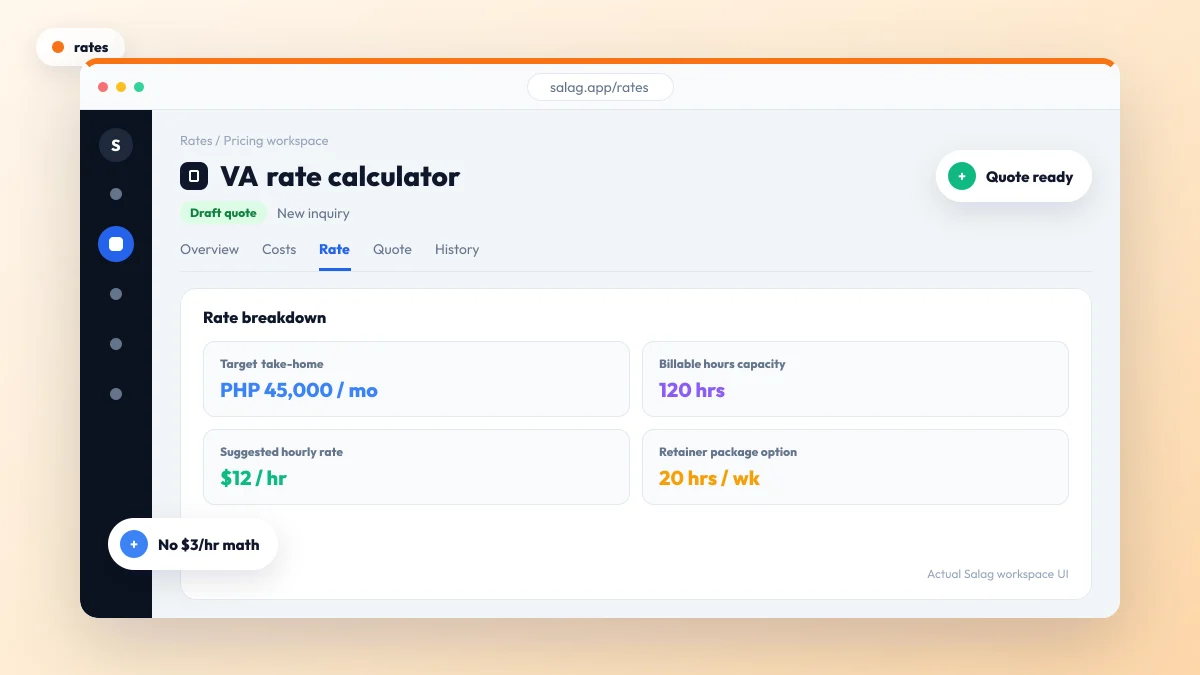
Use the Rate Calculator so the math is visible, not vibes.
Step 2: Write the market-facing offer
Pick one package shape for the lead:
- Weekly hour block with a task menu
- Deliverable package with revision caps
- Retainer with a clear "included / not included" list
Step 3: Quote above the floor with scope
If their budget is tight, shrink the list, not your dignity. Cutting rate to win "experience" while training the market under $5/hr is not Salag advice.
Step 4: Keep proof ready
Market talks get easier when you have delivery logs and approvals. See Document Work Clients Can't Dispute and the Work Receipt Generator. Proof supports price. Adjectives do not.
Scripts you can paste
When a client asks "What's your rate?" before scope
Hi [Name], happy to share pricing. To quote cleanly, can you confirm the weekly outcomes you need, the tools I'll use, and whether you want an hourly cap or a fixed weekly package? My floor for professional work starts at $5/hr with a written scope. Once I see the list, I'll send a clear package with revision limits.
When they push a peso-survival story
Thanks for asking how I price. I don't quote from household budgets. I quote from a written scope, turnaround, and revision limits, with a professional floor at $5/hr. If budget is fixed, I can slim the deliverables so quality stays intact instead of cutting the rate below a sustainable floor.
When budget is under your floor
I can help inside $[budget] if we cut to this list: [A], [B], [C], with [N] revision rounds and a weekly update. Expanding past that list would need a new quote. I don't drop below my $5/hr floor for open-ended "anything that comes up" work.
Common mistakes
- Using rent day emotion as the USD quote. Private floor ≠ public price.
- Copying unsourced rate tables. Label them teaching examples; demand a review date.
- Matching underpaying posts to "get experience." Skip or re-scope. Do not coach yourself to $4/hr or below.
- Ignoring unpaid admin. Chat and chasing invoices are real hours.
- Explaining your COL to clients. It invites pity discounts.
- Never updating the floor after rent or FX moves.
- Hourly only with no package edges. Endless scope hides under the same rate.
Example week: Maya (teaching story)
Maya in Cebu rebuilds her COL stack after rent rises. At 70 honest billable hours, her USD floor after a fee buffer sits above $5/hr. A lead offers a soft budget that would land under her floor for "general VA help."
Maya does not argue about groceries. She sends a slim package: inbox triage three days a week, a Friday summary, and two revision rounds on templates. Price stays above her floor. The client either accepts the smaller list or increases budget. Either way, Maya did not sell her cost of living.
Comparison table: which anchor belongs where
| Situation | Use COL floor | Use market / package clarity |
|---|---|---|
| Deciding if you can accept a deal | Yes | Yes (check scope) |
| Writing the client proposal | No (keep private) | Yes |
| Negotiating a cut | Filter with floor | Offer scope cut |
| Planning next raise | Update COL + proof | Refresh package language |
| Explaining price on a call | No household story | Deliverables + boundaries |
How Salag helps
- Rate Calculator: turn peso costs and billable hours into a USD floor
- Rate Negotiator: reply when budget and scope disagree
- Rate Evolution Monitor: track raises without guessing
- Work Receipt Generator: attach proof to price talks
- Related reads: Why Salag Recommends a $5/Hour Floor, When to Cut Scope Instead of Cutting Rate
Regional reality without one fake average
Manila, Cebu, Davao, and hometown costs differ. Family support differs. That is why Salag pushes a method, not one magic peso number for the whole country. Your COL floor is local. Your client quote is still international and written in clear packages.
If you support family across cities, put that in the private stack. Do not put it in the sales pitch.
Beginners: experience without training the market down
New VAs often hear "start low to learn." Learning is real. Training clients to expect disposable rates is costly. Salag's path:
- Take tight, written scopes at $5/hr+
- Log deliveries and approvals
- Raise or slim clients at review time
Skip posts that only work if you ignore fees, tax reserve, and sleep.
When to re-apply COL vs market
Re-run COL when costs or FX jump, or quarterly. Refresh market packaging when your proof trail grows, when tools change, or when scope creep becomes normal. If you only update one side, you either undercharge or over-explain.
Definitions
Cost-of-living floor: Private minimum after real costs, unpaid admin, and fee buffer.
Market-facing price: Client quote built from package clarity and scope, always at or above your floor.
Underpaying post: A request that only works below a sustainable floor (Salag treats $4/hr and below as skip territory, not coaching).
Package: A priced offer with included work, limits, and turnaround.
Final thoughts
Cost of living vs market rate for Filipino VAs is not a personality test. It is room assignment. Pesos plan your floor. Packages sell the work. Keep Salag's $5/hr floor. Keep household math off the proposal. When budget is tight, cut scope, not your future.
Run your numbers in the Rate Calculator, write the package, and protect the floor in writing.
In short
Cost of living vs market rate for a Filipino VA is two different jobs. Use peso cost-of-living math to set your private floor. Use clear packages, scope, and client-facing market clarity to set the quote. Keep Salag's $5/hr floor. Never sell your household budget as the price story.
Common questions
Cost of living vs market rate for a Filipino VA is two different jobs. Use peso cost-of-living math to set your private floor. Use clear packages, scope, and client-facing market clarity to set the quote. Keep Salag's $5/hr floor. Never sell your household budget as the price story.
Cost-of-living anchoring means you build your personal floor from rent, food, internet, tools, tax reserve, and unpaid admin hours. You use that number to decide what you can accept. You do not paste that peso math into the client quote as the selling story.
Market anchoring means your client-facing price reflects clear packages, scope, and how similar work is usually sold to international clients. You still respect your cost floor. You lead with deliverables and boundaries, not with your household budget.
Clients buy outcomes and hours in USD (or another foreign currency). A round peso target from rent day can make you quote too low after fees and unpaid chat. Convert your floor to USD, then price the package above that floor with clear scope.
No. Cost-of-living math is private planning. Client conversations stay on scope, turnaround, revisions, and price. Sharing household costs invites pity pricing and awkward negotiations.
Salag recommends a $5/hr floor for professional freelance work sold to international clients. Do not treat $4/hr or below as Salag coaching. Use the Rate Calculator to build your own floor from real costs and billable hours.
Rebuild your monthly needs in pesos. Divide by realistic billable hours. Convert to USD with a fresh exchange rate. Add a buffer for payment rail fees. Then quote a package or hourly rate at or above that USD floor.
Job boards show underpaying posts. That is not your cue to match them. If a request sits under your floor, decline, cut scope for the budget, or walk away. Salag does not recommend racing below $5/hr.
Treat unsourced tables as teaching examples only until you see a review date and a clear method. Start any learning band at $5/hr+. Re-check fees, niche, and your proof before you treat a number as market data.
Packages are the clean market-facing side. Name the weekly hours or deliverables, revision limits, and response window. Your COL floor tells you whether that package still covers you after fees.
Your floor is personal. Manila rent and province rent are not the same. Build COL from your real city or household. Do not copy a friend's floor or a viral peso target from social media.
Recheck when rent, internet, tools, or exchange rates jump, or at least every quarter. A stale peso floor turns into a stale USD quote and quiet undercharging.
ALIGN still applies. Assess the request, list deliverables, set guardrails, invoice terms, then note next review. COL sits inside Assess. Market and package clarity sit inside List and Guardrails.
Use the Rate Calculator for floor math, Rate Negotiator for reply wording, and Rate Evolution Monitor when you track raises over time. Keep proof in Work Receipts so market conversations stay about delivery, not adjectives.